Multi-Agent / 2025-10-08
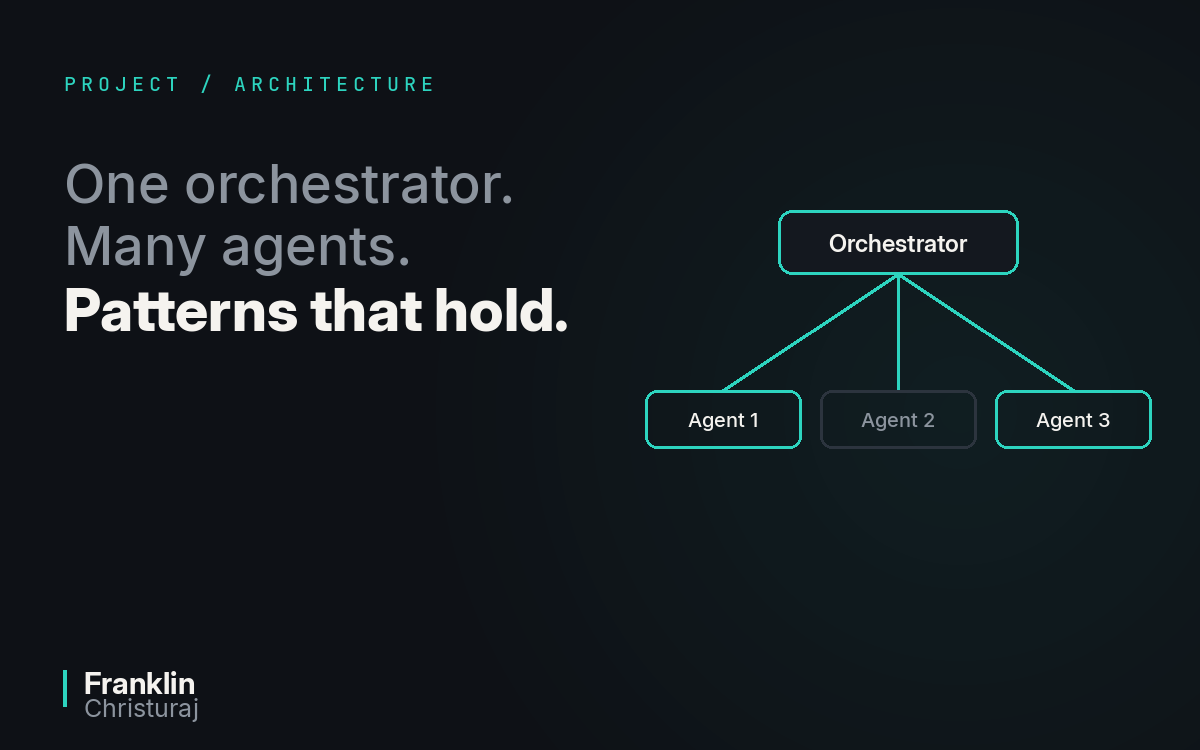
Multi-Agent Orchestration Patterns
Production patterns for coordinating multiple agents with human-in-the-loop checkpoints and single-source-of-state design.
Role
Architect. Pattern design, failure-mode analysis, production rollout.
Outcome
Cut a support agent's failure rate from 30% to under 5% by routing every agent through one state layer with human-in-the-loop checkpoints on high-cost actions.
Everyone's arguing about which model to use. The model was never the question.
When you wire several agents together, the failure isn't intelligence. It's coordination. Each agent holds one piece of the picture, none of them agree, and the whole system promises things the business can't allow.
The pattern that fixes it: one place the state actually lives, that every agent reads before it acts. Plus human-in-the-loop checkpoints where the cost of being wrong is real. I call it single-source-of-state: an agent is only as reliable as the one place it can trust to tell it the truth.
I saw this break live. A two-agent support system (one triaged, one replied) and they disagreed about whether a refund had already been issued. Each had cached a different version of the account state. The reply agent promised a refund the triage agent had already actioned, and the customer got a double credit. The fix wasn't a bigger model. It was routing both agents through one shared state layer and gating any refund above a threshold behind a human checkpoint. Failure rate dropped from ~30% to under 5%, and the remaining failures were typos, not coordination breaks.
Every enterprise agent I've seen fail in production failed here first. Not at the model.